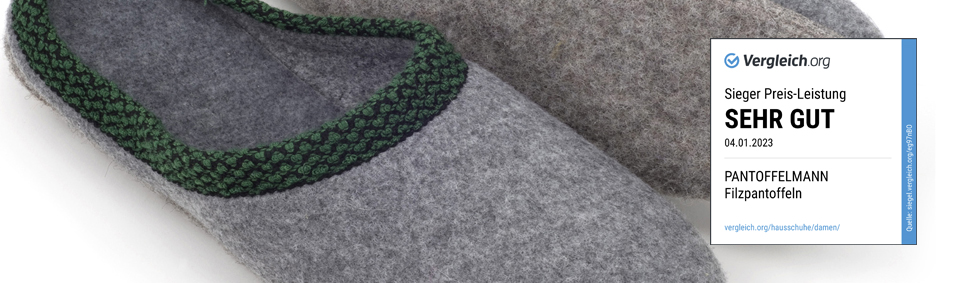
Felt slippers Men: Durable and comfortable
The slipper is a good choice for evereyone, there die comfortably and reliably liking. Robust and durable Provide felt slippers absoloute comfort and ability over many years being carried. A precondition for more than durability is a correspondingly high quality and that's why our felt slippers are made for men with special care and only high quality materials.
If you search felt slippers for men, which persuate you in your daily use, then you are exactly right in our shop.
Our slipper for men: Large selection and competitive prices for high-quality slippers for men.
In our great assortment you can find felt slippers for men in many different versions. The individual models differ primarily in the shape and in the sole.
Felt clogs
For all, those who need solid soles, because they want to wear your slippers even outdoors, are our felt clogs ideal. This slippers for men have a soft anatomical footbed and a very stable sole. Thanks to high quality production you will accompany these felt slippers for men over many years.
Light felt slippers
Those looking for lighter slipper for use indoors, is with us also find. We offer them numerous models with one lighter, non-slip rubber sole or one robust felt sole. These slippers for men are ideal as flexible slipper.
Over slippers
Felt slippers for men are available not only for private use with us. Also museum slippers and over slipper suitable for guests or work in construction, you will find in our range.
No matter which of our felt slippers for men you choose: With us you can always rely on the highest quality from Germany. We are specialists for felt and are always striving to provide you with reliable and durable footwear at an attractive price.
Felt slippers for men and more: Discover with us not only felt slippers for men, but also other footwear.
If you are looking for slippers for men, then you are exactly right with us. Benefit from our wide range and place on top quality at an attractive price-performance ratio. Not only high quality slippers for men, other kinds of footwear can be found in our shop. In the category east products we present as the iconic Jesus slaps and Trampers who you may remember from your youth or want to know now.
You have a question about felt slippers for men? Then contact us. By our contact form, we answer your questions quickly and can assist with any requests personally on.
When people think of genuinely comfortable slippers, they almost automatically end up at felt. That is no coincidence. Felt slippers combine warmth, calm, everyday practicality and a very distinctive material character. They simply feel right at home—not loud, not technical, but perfectly suited to living spaces, workdays in the home office or other quiet indoor settings. That is exactly why felt slippers are the kind of models many people keep coming back to.
Anyone who looks more closely at the material quickly notices that felt is not just felt. There are different qualities, blends and use cases. On top of that, different sole types make a major difference in everyday use. That is what we will look at here step by step—without exaggeration, but with a focus on what users actually want to know.
Many people like felt slippers because they handle warmth in a very balanced way. Felt stores warmth without automatically feeling heavy or bulky. That matters in everyday life: at home, no one wants cold feet, but just as few people want a material that starts to feel stuffy after a short time.
That is why good felt models often create a calm, dry wearing sensation. The material feels warming, but not as if it completely seals off the foot. This combination of coziness and practicality is one of the main reasons why felt is so popular in living spaces, offices and vacation rentals.
A common mistake in communication around felt slippers is the broad assumption that all models are made from 100% wool. It is not that simple. Depending on the model and product line, different materials may be used—from wool felt and walk felt to blended felt or polyester felt.
For buyers, that is not a side detail. It matters for the wearing experience. A model made from wool felt can feel different from one made from a felt blend. Walk felt often comes across as softer and more textile-like. Blends or more synthetic variants can be more robust or more dimensionally stable. That is why it is always worth checking the material specification, not just the look.
|
Material type |
How it feels |
What to pay attention to |
|
Wool felt |
natural, warm, comfortable and often especially premium |
a good match when a classic, calm wearing experience is desired |
|
Walk felt |
softer, more textile-like, often more flexible |
interesting for anyone who prefers a slightly softer upper material |
|
Felt blend |
depending on the composition, robust and shape-retaining |
read the material specs carefully, because differences can be significant |
|
Polyester felt |
functional and practical for daily use, depending on the finish |
not automatically worse, but different from wool felt in feel and character |
Felt slippers are not just a winter solution. It is in quiet indoor settings that they really show their value. At home, they create warmth and a lived-in sense of comfort. In the home office, they feel more put-together than thick socks while remaining more comfortable than street shoes. In vacation rentals or guest accommodation, felt models project a pleasant balance of comfort and quality.
Many people also perceive felt as pleasantly quiet. That makes a difference when someone is already up early in the morning or when a shoe is needed that is gentle and quiet on sensitive floors. Felt therefore fits many living situations not only visually, but also acoustically.
When buying felt slippers, people often look at the upper material first. In daily use, however, the sole is almost just as important. It determines how quiet, flexible or robust a model feels, and whether it makes sense only for the apartment or also for short trips outside.
A classic felt sole feels soft, light and gentle on floors. It is a good fit for quiet indoor spaces where the goal is the softest and quietest possible walking sensation. If you also step briefly outside, into the basement or onto the terrace, rubber soles or EVA are often more practical in everyday life. ABS options, in turn, can provide more grip when smooth floors are an issue.
|
Sole type |
Advantages |
Especially useful for |
|
Felt sole |
quiet, light and gentle on floors |
living spaces, quiet indoor areas, a classic slipper feel |
|
Rubber sole / EVA |
more robust, grippier and practical for short walks |
households with hallways, terraces, basements or quick trips outside |
|
ABS |
more grip on smooth floors |
tiles, smooth surfaces and guest slippers |
Another advantage is that felt works in very different formats. Classic slippers, closed house shoes, felt clogs or models with more robust outsoles can all carry the same material character while behaving quite differently in daily use. That is why it makes sense to consider the material question together with the model question.
If someone wants a calm, uncomplicated slipper, they often end up with a classic felt model. Anyone who wants more support or a more defined walking sensation tends to look toward clogs or models with a stronger sole. Specialty materials or warmer variations can also make sense in this context—but always depending on the model.
Felt stores warmth in a very pleasant way while also creating a calm, home-like wearing sensation. Many users find that exact combination especially comfortable.
Felt stores warmth in a very pleasant way while also creating a calm, home-like wearing sensation. Many users find that exact combination especially comfortable.
No. Depending on the model, manufacturers may use wool felt, walk felt, felt blends or polyester felt. That is why the material information on the individual product matters.
A felt sole is especially suitable for quiet indoor spaces and for a soft, floor-friendly walking sensation. Rubber or EVA are more practical when short trips outside or more robust everyday use are part of the picture.
Not necessarily. Many people wear felt slippers all year round because the material is not only warm, but also often perceived as pleasant and balanced in everyday use.
The best starting point is the intended use: classic for home, more robust for short walks, quieter for sensitive floors, or with a stronger sole for greater everyday versatility. After that, it makes sense to refine the choice by material and shape.
Slippers are often underestimated at home. Many people spend hours walking on tile, wood or vinyl without giving much thought to what the foot actually has to do in the process. That is the point at which slippers with a footbed become interesting. They are not meant to feel medical, and they should not promise miracles—but they can make the walking experience at home noticeably more comfortable.
The product world around felt clogs with a footbed shows particularly well why this topic matters: a warm upper material, a more structured build in the foot area and a sole that cushions daily life at home better than a completely flat model. Anyone who stands a lot, walks on hard floors or simply prefers a more stable sensation often looks specifically for slippers like these.
Not every soft insole is automatically a footbed. A true footbed is shaped. It does not simply follow the outline of the shoe. Instead, it supports certain areas of the foot more deliberately—for example around the heel or under the arch. That creates a more structured sensation when standing and walking.
In everyday use, many people notice the difference immediately. A flat slipper tends to feel neutral or simply soft. A model with a footbed gives the foot more guidance. That does not have to feel hard, but it is usually more clearly perceptible. For many users, that is the reason they prefer felt clogs or slippers with an anatomically shaped construction at home.
The decision depends very much on how the shoe is used. If someone mainly wants to slip in and out quickly, a very simple model may be perfectly sufficient. Anyone who walks a lot at home, stands for longer periods or appreciates more defined support will usually notice the difference a footbed makes much more clearly.
|
Feature |
Flat insole |
Shaped footbed |
|
Wearing sensation |
soft or neutral, but with little guidance |
more structured, more stable and often more defined when standing |
|
Support in the shoe |
rather simple |
usually better guided |
|
Daily use on hard floors |
fine for short distances |
often more pleasant for longer periods at home |
|
Preferred by many users |
when simplicity matters most |
when comfort and structure matter more |
The benefit becomes especially clear in typical daily situations: in the kitchen in the morning, during the day in the home office, while doing laundry, on a quick walk through the house or whenever someone is moving for longer periods on hard floors. In exactly those moments, a shaped footbed can create a calmer and more comfortable walking sensation.
That does not mean such a slipper solves medical problems. But it can make the difference between something that feels merely acceptable and a product that people genuinely enjoy wearing every day. That is why many users prefer slippers with a footbed when they are not just sitting at home, but moving around a lot.
At Pantoffelmann, the combination of felt and a footbed is particularly easy to understand. Felt brings warmth, calm and a home-like material feel. The footbed complements that soft material side with more structure and support. Together, the result does not feel technical. It feels practical and suited to everyday life.
That is also why felt clogs with a footbed are such a convincing solution for many people. They are easy to slip on, often feel more stable than very simple slippers and combine comfort with a clearer shape. Anyone looking for a model that feels not only soft but also dependable at home often ends up in exactly this category.
These models are not designed only for a tiny niche. They are especially interesting for people who spend a lot of time on their feet at home or live with hard floors. That can include people who work from home, parents, people with long walking distances inside the house, or anyone who quickly feels fatigued when barefoot or in socks.
They can also be a good intermediate solution for anyone who finds very soft slippers too undefined but does not want the firmness of street shoes indoors. This is not about diagnoses. It is about lived daily experience: a more structured slipper can simply feel better at home.
In daily life, slippers rarely stop exactly at the apartment door. Often there is a quick trip to the trash bin, the patio, the yard or the mailbox. In those situations, a robust outsole is very useful. It gives the shoe more everyday versatility and means short walks do not require changing shoes every single time.
That is exactly why it is worth looking not only at the footbed, but also at the underside of the model. A well-made outsole can significantly expand the comfort of a slipper—especially when the shoe is expected to do more than just cover a few steps in the living room.
Anyone looking for slippers with a footbed should keep four points in mind: first, the shape of the footbed itself—softer, more structured or more classic in feel. Second, the upper material. Felt creates a very different sensation from a smoother material. Third, the outsole. And fourth, how the slipper will actually be used at home.
It also helps to ask honestly what kind of product is really being sought: a very warm, rather soft slipper, or a model that combines warmth with stability. That is exactly where different product worlds begin to separate. Anyone placing more emphasis on structure and support will often end up with felt clogs or slippers with a clearer footbed design rather than very simple slip-ons.
In summary, a good footbed does not turn a slipper into a medical product—but it can make it much more suitable and comfortable for everyday life.
A soft insole mainly cushions. A true footbed is also shaped and gives the foot more structure and guidance when standing and walking.
No. They can be interesting for anyone who spends a lot of time standing at home, walks on hard floors or simply wants a more stable wearing sensation.
Felt creates a pleasant, warm upper material. The footbed complements that soft material side with more support and structure. Many users find exactly that combination especially coherent.
Yes. It makes short trips outside more practical and can make the shoe more versatile overall without taking away its home-friendly character.
The fit, the shape of the footbed, the upper material, the outsole and the way the slipper will actually be used at home. Only the combination of those factors determines whether a model is truly suitable.
A guest steps into your home, takes off their street shoes—and then what? What goes on their feet next often determines the very first moment of comfort. As an attentive host, you want to offer convenience without having to search awkwardly for suitable slippers. That is where a simple but brilliant solution comes in: the slipper basket.
It is far more than just a storage place. A well-stocked slipper basket is a gesture of hospitality that creates order and immediately makes guests feel welcome. In this article, we show why the slipper basket is the centerpiece of a thoughtful welcome culture.
When guests enter your home, they want to relax. Cold tiles, delicate parquet floors or simply the desire to get out of street shoes make a pair of slippers feel like a small luxury. A prepared selection of guest slippers sends a clear signal: feel at home, we thought of you. This small gesture keeps feet warm, protects floors from dirt and scratches, and creates a cozy, private atmosphere.
Individual pairs of guest slippers can quickly look untidy or disappear into a shoe cabinet. A slipper basket solves that problem elegantly. It gathers the selection in one central, easy-to-see place—usually right by the entrance.
• Inviting presentation: Instead of an untidy pile of shoes, the basket presents the slippers neatly and within easy reach.
• Immediate visibility: Guests do not have to ask. They see the offer right away when they arrive and can help themselves.
• Order in the hallway: The basket prevents used guest slippers from being scattered around the entrance area.
• Flexibility: A basket can easily be moved when needed—for example from the hallway to the guest room.
The best basket is only as good as what it contains. For the gesture to land well, the slippers should meet a few key criteria.
A size mix instead of a one-size solution
Nothing is more unsuitable than a slipper that is far too small or obviously too large. A good slipper basket therefore contains a mix of common sizes. That is what makes it practical in everyday life: guests do not have to improvise, but can immediately find something that fits.
Reusable instead of generic
While disposable slippers often feel anonymous and low-value, reusable guest slippers communicate much more care. They are more comfortable, more durable and a better match for a high-quality impression at home, in a guest room or in a vacation rental.
Material and sole naturally play a role—but more of a supporting one. They are not the heart of the topic, yet they help place the benefit of a slipper basket in everyday context.
Why felt fits this concept so well
Felt is so popular for guest slippers because the material feels warm, home-like and pleasant. It supports exactly the feeling hosts want to create: calm, comfort and a refined, understated culture of welcome.
Depending on the flooring, a different sole type may be useful. For delicate floors and quiet walking, a felt sole is a very good fit. If more grip is needed on smooth surfaces, ABS nubs can be more practical.
|
Sole type |
Characteristic |
Ideal for |
|
Felt sole |
quiet, soft and gentle on floors |
parquet, laminate, carpet and calm indoor areas |
|
ABS sole |
slip-resistant thanks to nubs |
smooth tiles, entrance areas and floors with more risk of slipping |
A slipper basket does not only make sense in a private hallway. It is also effective in guest rooms, vacation rentals, small hotels or guesthouses. Anywhere guests arrive and should be able to orient themselves quickly, it creates a tidy, prepared impression.
In exactly those situations, its real value becomes visible: the slipper basket turns individual guest slippers into a coherent offering. It simplifies the welcome, improves the feel of the room and removes small uncertainties from the arrival experience.
Conclusion: a small detail with a big effect
A slipper basket is much more than a practical storage solution. It is a sign of thoughtful hospitality. It creates order, offers comfort and lets guests know in an understated way that they are welcome. This small decision makes a big difference in everyday life—and that is exactly why a slipper basket for guest slippers makes so much sense.
A slipper basket keeps things tidy, gathers all pairs in one place, and makes the offering immediately clear to guests. Loose slippers can quickly look random or untidy.
A mix of common adult sizes is the most practical choice. This makes it more likely that guests will find a suitable pair right away.
Because they do not look like a temporary solution. They convey care, comfort, and the impression of a thoughtful host.
Ideally, it should be placed where guests take off their outdoor shoes — usually in the hallway, entrance area, or guest room.
That depends on the type of flooring. Felt soles are well suited for quiet use and are gentle on floors. ABS grips are more practical when extra traction is needed on smooth surfaces.